
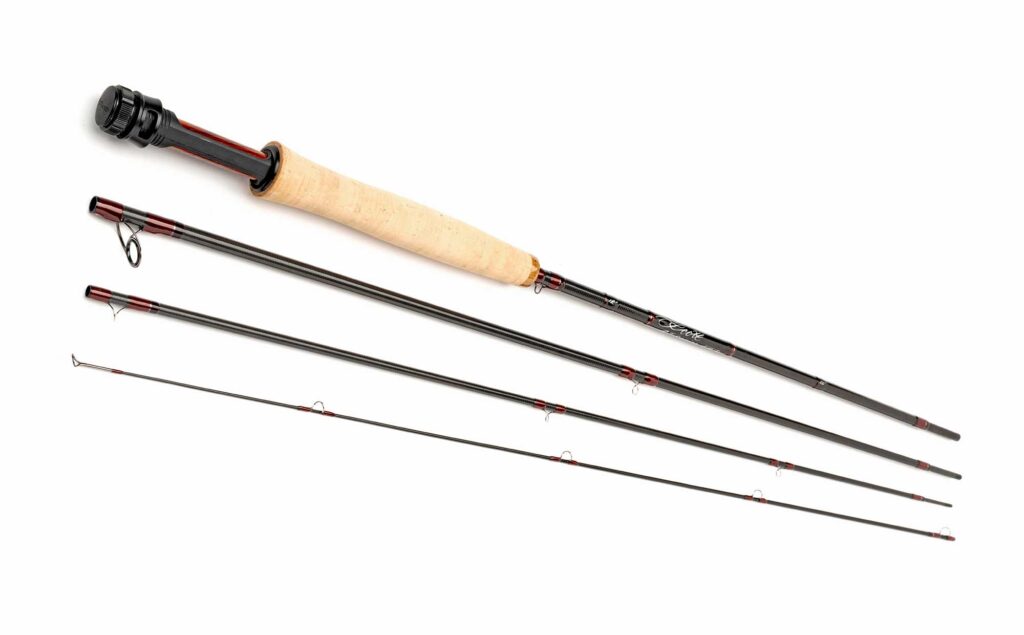
 Everyone knows I lean favorably toward Scott fly rods. I called the Radian the greatest fly rod ever made in a Field & Stream review many years ago. I felt that Centric was worthy of a comparison to AC/DC’s “Back in Black” album. I fish Sector in the salt, and consider Session the best dollar-for-dollar value on the fly rod market today.
So, what the heck do you expect me to say about the new “GT” series?
Yes, I love it. And yes, I highly recommend it. But maybe not for just anyone.
For the record, “G” series goes way back to the roots of the Scott Fly Rod Company. Back in the 1970s, founder Harry Wilson (he named the company after his son) produced a medium-action graphite rod with hollow internal ferrules that stood apart from the field. He called it the “G” (for graphite, as the “F” series were made of fiberglass). I like to think that, while the rod naming wasn’t exactly innovative, the design was. Indeed, it set a standard for feel and responsiveness and gathered a cult following amongst certain casters.
It took bold moves to improve upon G. But after 30 years, “G2” was launched in 2006. To be honest, I wasn’t enamored with G2. The company itself sought better with the launch of a new “G” in 2017, and that series has lived up to its billing, especially for certain applications like dry fly fishing in technically demanding water. Some models like the 8-foot-8-inch 4-weight stand apart, and if you have one, it’s a keeper.
I was actually a bit skeptical when GT arrived a couple months ago. But I’ve been fishing it in different environs—from a dory, walk wading small streams, lake fishing with float tubes… fishing in Michigan, Idaho and Colorado for fish of various sizes. This what won me over.
It feels lighter, though the reel you choose makes or breaks that factor. Out of the tube, you’ll sense a difference. That’s because the manufacturing process for the new GT allows for thinner-walled blanks (the thinnest Scott has ever made). The ferrule connections shed bulk to the point that a four-piece rod feels like a one-piece rod.
I’m not sure if the T in GT stands for thin, or technical, or what. I know it isn’t Giant Trevally, because this is a thoroughbred trout rod. Maybe a play on “Ford GT” since it is sporty?
The rod tracks and recovers well. It’s accurate. I’d rate it right up there with Orvis Helios (gen 4, the new ones) that I think are among the most consistently accurate rods out there.
Most important of all, the feel transfer… you can sense the energy during the cast, not just in the tip section, but also right through the lower section and into the grip. If you can sense the energy, you can control it. That means you make more consistent casts. But it also allows you to improvise. Little flicks and mends, the unheralded things that often spell the difference when it comes to presentation, are augmented through this rod.
I make better roll casts with this rod than I do with any other rod.
I can change my loops from compact to open (at will) more easily with this rod.
I am more consistently on target with single casts (no multiple false casts) with this rod.
I feel like I fight fish more effectively with this rod. Again, that feel factor matters, and allows for reacting and adjusting.
It’s an intuitive, instinctive rod. You might not realize the adjustments you’re making as you make them.
Things other, faster-action rods do better than GT: Shooting line. Distance casts of 50 feet or more (who needs them anyway?). Euro nymphing. Slinging lead.
But overall, for the type of fishing I like best (and by all means, you be you), I fish better with this rod. Not just cast better… fish better.
It isn’t a slow, slushy rod. It isn’t zippy fast. It’s just right, at least for fishing dry flies, especially single flies. For the record, I did fish some small streamers with the 4-weight I have, and that was fine. Sight nymphing was fine also, but the rod shines brightest with dry flies between #10 and #20 in size (basically 99.99% of the dry-fly patterns I fish).
Available from 7’ 4” to 9’ 8”, in four and five-piece configurations for 3-weight to 6-weight lines, I think the 8-foot 10-inch 4-weight is the “butter” stick in the lineup.
Price is north of a grand now (MSRP $1095) so it doesn’t qualify as a beginner’s rod.
And to be honest, the dyed-in-the-wool self-proclaimed expert who has had an ongoing love affair with a favored rod should probably stick to what they like best.
The angler who will benefit most is one who wants to go from good to great; the B caster/angler who wants to go up to A level. Of course, nothing will help that performance curve better than actual time on the water and practice. No piece of gear is a cure-all. But yes, I’ll vouch that this rod will make an angler who wants to get better—particularly better at the technical game—much better if they put in the work. And I think that applies to a wide range of styles and interests.
In eager and diligent hands, Scott’s GT can absolutely be a game changer.
-Kirk Deeter

1 Comment
Let’s or ignore the fact that Scott is one of the few manufacturers that does not sell customer direct; does not have an online retail division/website designed with the single goal of competing directly with its retailers; does not collect consumer data from their registration information and use it to strengthen its direct sale: does not offer periodic consumer direct or first-time online purchase direct discounts and has a history of supporting rather than diluting the role of the (shrinking number of) retailers in our sport.